

Kitchen
The biggest volume: a run of cabinets, the doors, the benchtop and the appliances.
- The heavy piece
- A stone benchtop, or a long laminate run in one piece.
- Check first
- The sheeting behind an old tiled splashback.
We take away what comes out: the cabinets and benchtop, the vanity, the toilet and bath, the tiles, the screens and the old appliances. We book the load around the day the old one comes out, so it isn't taking up the carport when the new one is delivered.
We take what's been pulled out. Whether we pull it out, ask us.
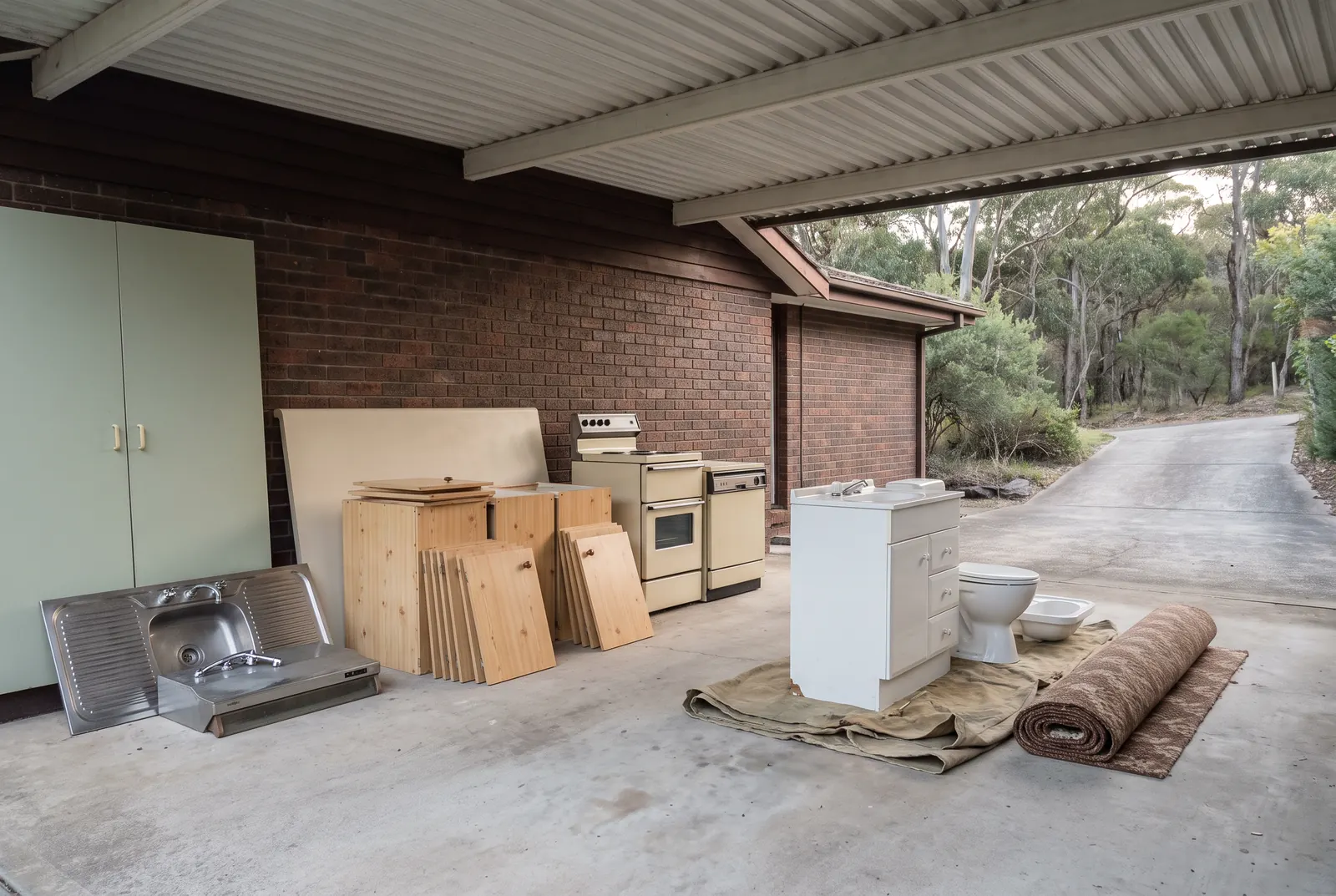
The middle of the three renovation loads. All three loads
A kitchen or bathroom isn't one kind of rubbish. We load it by material so each part can go where it's accepted, and so metal and anything else that can be recycled isn't buried in general waste.
| Material | What it is | Where it goes |
|---|---|---|
| Metal | The sink and tap set, the rangehood, shower screen frames, towel rails, and a steel or cast-iron bath. | Scrap metal recycling. It's the simplest part of the job to recycle, so it travels as one pile. |
| Appliances | The oven, cooktop, dishwasher, and a fridge the new kitchen has no room for. | Metal recycling. A fridge needs a whitegoods recycler, because its refrigerant gas has to be recovered before the metal is. If something still works, tell us. Selling or giving it away before the day is often worth a try. |
| Cabinets and doors | Base and wall carcasses, doors, drawer boxes, kickboards and the vanity, mostly particleboard or MDF with a laminate face. | A licensed waste facility. Laminated particleboard rarely has a recycling route, so it goes as general waste. Solid timber goes with the timber. |
| Benchtops | Laminate, timber, natural stone or engineered stone. | Laminate as general waste, timber with timber. Stone is heavy, so its weight goes into the price. Leave engineered stone whole. Cutting it releases silica dust. |
| Tiles and ceramics | The toilet and basin, wall and floor tiles, and the mortar bed from under an old shower. | A facility that takes heavy inert waste. This is usually the heaviest part of a bathroom, and the price allows for it. |
| Glass | Shower screens, the mirror, a glass splashback. | With the load to the facility. Toughened glass doesn't belong in the yellow recycling bin, which is for bottles and jars. |
| Floors | Carpet and underlay, floating floor and its foam, timber boards, skirting. | Carpet and underlay as general waste. Timber goes with the timber. Old vinyl or lino waits until it's been tested. |
| Linings and offcuts | Plasterboard, cornice, and the boxes the new cabinets arrived in. | Plasterboard to a facility that accepts it. Packaging usually goes with the after-handover load. |
We'll point you to where each of those can go.
Each room leaves a different load behind. These are the parts that shape how we carry it and what we ask you before we come.
The biggest volume: a run of cabinets, the doors, the benchtop and the appliances.
Less volume, more weight: tiles, the mortar bed, the toilet, the bath.
Often done with the kitchen: the tub and cabinet, overhead cupboards, the old washer or dryer.

In a house built before 1990, the NSW EPA expects some asbestos. In a kitchen or bathroom it's most often in the fibre-cement sheeting behind old splashback and wall tiles, and in the backing of old vinyl and lino. Have a sample tested before anyone takes those off the wall or up from the floor.
We don't take asbestos or untested sheeting. An area of bonded asbestos larger than 10 square metres, or friable asbestos of any amount, must be removed by someone holding a NSW asbestos removal licence. The state's asbestos site shows how to find one. Once the result is back, we book the load around it. What to test, and who does it
Northern Beaches Council's bulky goods collection is built for household items, not renovations. It takes one built-in item per collection, and it doesn't take renovation or building material at all.
So a single old vanity can go out on a council pickup. A kitchen with eight cabinets, a benchtop longer than 1.8 metres and a tub of tiles can't, and neither can the bathroom's screens and mirror.
From the council's what we can and can't collect and booking pages.
Most old kitchens wait a day or two in the garage or carport. The new cabinets usually arrive flat-packed and need that same space, so book our load for before the delivery.
Anything still on the wall behind old tiles, or still on the floor under old vinyl, stays where it is until it has been tested.
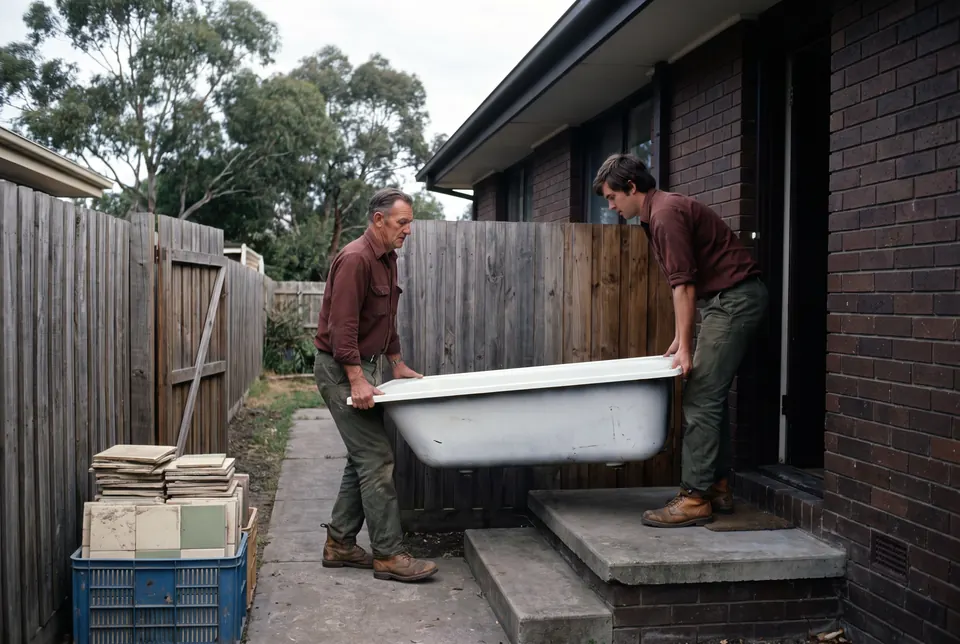
Some kitchen and bathroom quotes include taking the old one away; plenty say it's "by others". If yours does, this is that part. Tell us the day it comes out and where it will be stacked.
Give us your strip-out day. We load from wherever your team stacks it, so the drive and the garage are clear for the new cabinets and your next job isn't waiting on the last one's rubbish.
On a bigger job we take the whole items a skip wastes space on: cabinets, baths, vanities and whitegoods. On a cul-de-sac with no room for a skip, we load straight from the house.
Our job is taking it away once it's out. Anything connected to water, gas or power has to be disconnected by a licensed plumber, gasfitter or electrician before it moves. Whether we lift out cabinets that are already disconnected depends on the job, so tell us what's there when you enquire.
A single vanity, sink or toilet can, as the one built-in item council allows per collection. The tiles, the screen, the mirror and the rest of the bathroom can't. If you're keeping the council pickup for something else, we take the lot in one load.
Yes. Stone is heavy, so its weight is part of the price, and it may need more hands to carry. Please don't cut an engineered stone top into smaller pieces to make it easier; the dust from cutting it is the hazard.
Yes, bagged or in tubs. Tiles and mortar are the heaviest part of a bathroom, and we price for that when we look at the load. The sheeting the tiles were stuck to is a separate question: it gets tested first if the house was built before 1990.
Let us know the new date and we move the booking to match. Installation dates shift often, and the only fixed rule is that the old kitchen should be gone before the new one needs the garage.
No. Leave it where it's under cover: the carport, the garage or under the house. We carry from there, sloping drive and all, and sweep where the pile stood.
One fixed price, agreed after we've seen the pile and before we lift anything. Volume, weight and how far we carry it are what move it: a kitchen of cabinets is mostly volume, a bathroom is mostly weight.
A few lines is plenty. We ring you back, come and look at it, and agree one fixed price before anything is lifted.

No hourly rate, no tip fees on top. The price covers loading, sweeping up and taking it to a licensed facility. If the job changes on the day, we agree the change before we carry on.