

This guide belongs before the trades start.

Old eaves sheeting or vinyl underlay? Get it tested first.

If your renovation will lift old vinyl, take tiles off a wet-area wall or cut into the eaves, have those materials tested before anyone starts. The result decides who can take them out, and we book our loads around it.

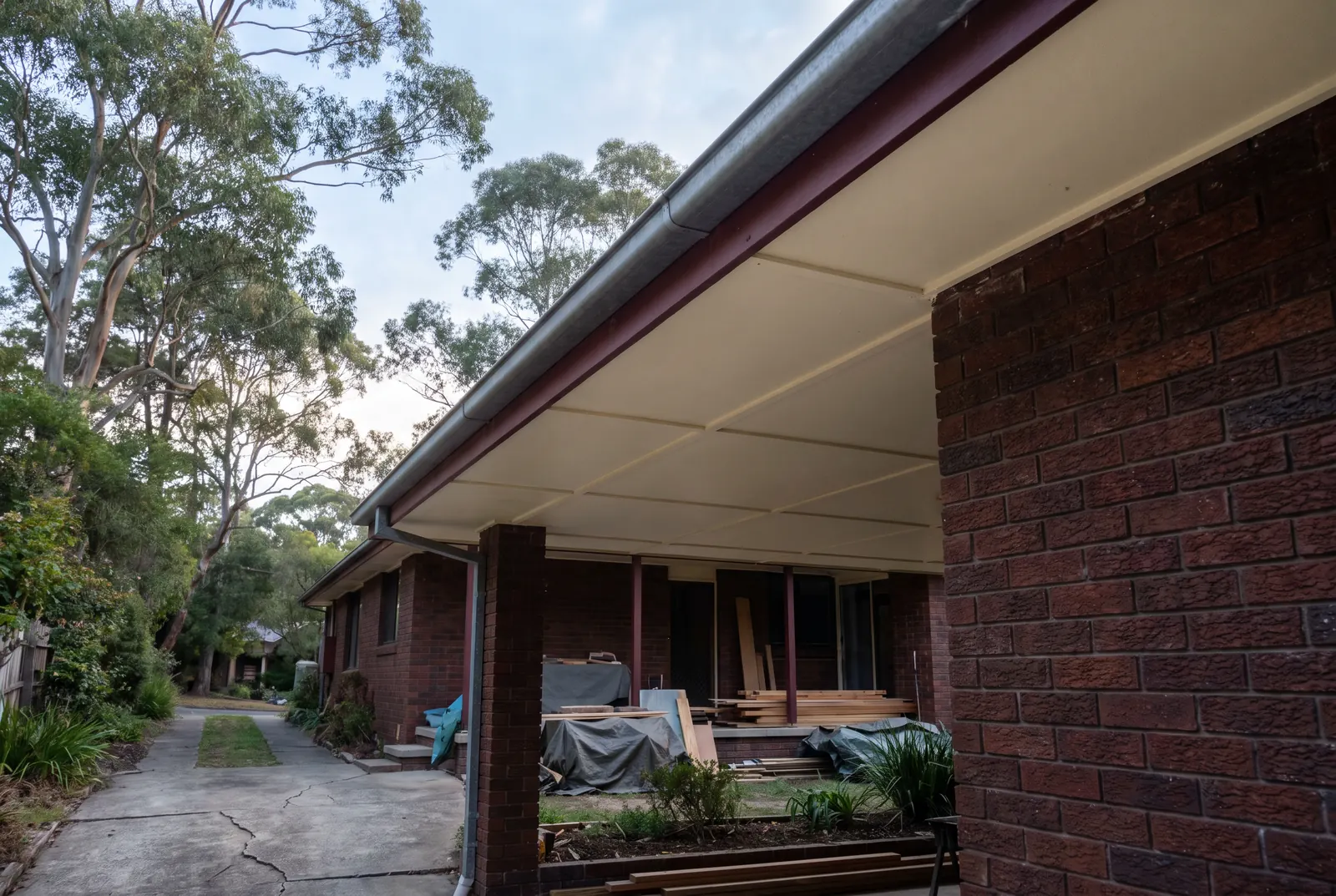
The underside of a brick house's eaves, lined with flat cream sheeting behind a red-brown fascia, with timber and tarps from a renovation on the patio below

Why a house built before 1990 gets checked

The NSW EPA puts it simply: if your house was built before 1990, it probably has materials in it that contain asbestos. Davidson's houses went up from the late 1970s on, so going by that, an original house here may well date from before 1990. That's a reason to check. It says nothing certain about your walls.

According to asbestos.nsw.gov.au, asbestos went into more than 3000 building products before 1990, and there's no way to tell by eye whether a sheet is one of them. A laboratory test of a sample is the only confirmation.

Sealed, painted and left alone, bonded asbestos is lower risk. A renovation is what changes that. Prising off tiles, lifting old flooring, cutting a hole for a downlight or a new window: that's when fibres get into the air.

Built before 1990
Probably contains asbestos (NSW EPA)
By looking
Can't be confirmed. Only a lab test can.
Who tests
A licensed asbestos assessor or an occupational hygienist
The result
A Certificate of Analysis endorsed by NATA

Where it sits in a renovation

The materials worth testing are the ones your renovation will touch. A new kitchen disturbs the splashback wall. A bathroom disturbs the wall behind the tiles and the floor under them. New floors disturb whatever the old vinyl was stuck down with.

Old vinyl deserves the most care. asbestos.nsw.gov.au lists the backing under old vinyl flooring and floor tiles as friable asbestos: the kind that crumbles, and the kind with the strictest rules.

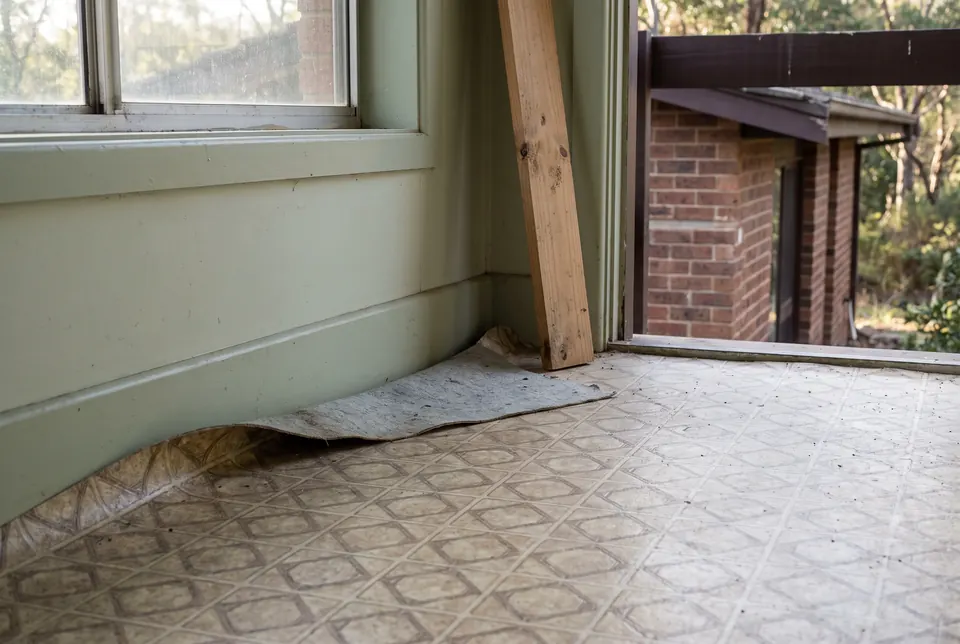
Patterned old sheet vinyl on a laundry floor, curling up at the skirting to show a grey fibrous backing underneath

By the part of the house being worked on

Bathroom, laundry and kitchen

  • Wall sheeting behind old wall tiles
  • The splashback wall behind an old kitchen
  • Sheeting under old floor tiles

Disturbed when the tiles come off, because the sheeting's face comes with them.

Floors

  • Old sheet vinyl and lino, with its backing
  • Flooring underlay
  • Old vinyl floor tiles and what's under them

Disturbed when it's lifted, scraped or sanded to get to the boards or slab.

Eaves, ceilings and walls

  • Eaves linings
  • Flat-sheet ceilings and internal walls
  • Textured or “popcorn” ceilings
  • Insulation around pipes and under the roof

Disturbed by downlights, a moved wall, a new window or door, or re-roofing.

Outside and the shed

  • Fibro sheds, cladding and old fences
  • Roofing, flue pipes and fireplaces
  • Garden beds and soil where old sheeting was buried

Disturbed when a shed comes down, a fence is replaced or the ground is dug for a deck.

Going into the roof space? Some NSW homes had loose-fill asbestos put in as ceiling insulation in the 1960s and 70s. If you're not sure what's up there, the EPA's advice is to stay out of the ceiling and call a licensed asbestos assessor.

Bonded or friable: who can take it out

What the test finds, and how much of it there is, decides who is allowed to remove it. SafeWork NSW licenses the contractors who do.

Bonded

Asbestos set in cement or another binder. Dry, it won't crumble in your hand. This is the usual kind in a house.

  • Fibro sheeting and cladding
  • Eaves linings
  • Wall sheeting behind tiles
  • Corrugated roofing

More than 10 square metres in total must be removed by a licensed asbestos contractor.
Friable

Dry, it crumbles to powder in your hand. Bonded sheeting becomes friable once it's broken, damaged or burnt.

  • Backing under old vinyl and floor tiles
  • Pipe and roof insulation
  • Textured or “popcorn” ceilings
  • Loose-fill ceiling insulation

Any amount at all must be removed by a contractor with a friable licence, and an independent licensed assessor issues a clearance certificate before the area is used again.

Ten square metres, drawn to one scale

  • Eaves lining 600 mm deep reaches 10 square metres in about 16.7 metres of run, roughly the front of a house.

  • The walls of a small bathroom, 2.4 by 1.8 metres with a 2.4 metre ceiling, come to about 20 square metres floor to ceiling: twice the line, before the door and window are taken off.

  • A floor 3.2 metres square, about a small bedroom, is 10 square metres of old vinyl. If its backing is friable, any amount needs a licensed contractor, so the 10 square metre line doesn't come into it.

Olive is the first 10 square metres. The dashed part is beyond it.

The order it goes in

  1. List what the work will disturb

    Walk the job with your builder or installer: which walls lose their tiles, which floors come up, whether anyone cuts into the eaves, the ceiling or the shed. That list is what gets tested.

  2. Have it inspected and sampled

    A licensed asbestos assessor, or an occupational hygienist, takes the samples and has them tested. SafeWork NSW licenses assessors and publishes who holds a licence.

  3. A licensed contractor removes what's found

    Bonded over 10 square metres, or friable in any amount, goes to a contractor licensed for it. You can check any licence on SafeWork's site before you book.

  4. Then the trades, and our loads

    With the result in hand, or the area cleared, the room is an ordinary renovation again. We empty it before the trades and take the rest as it comes out.

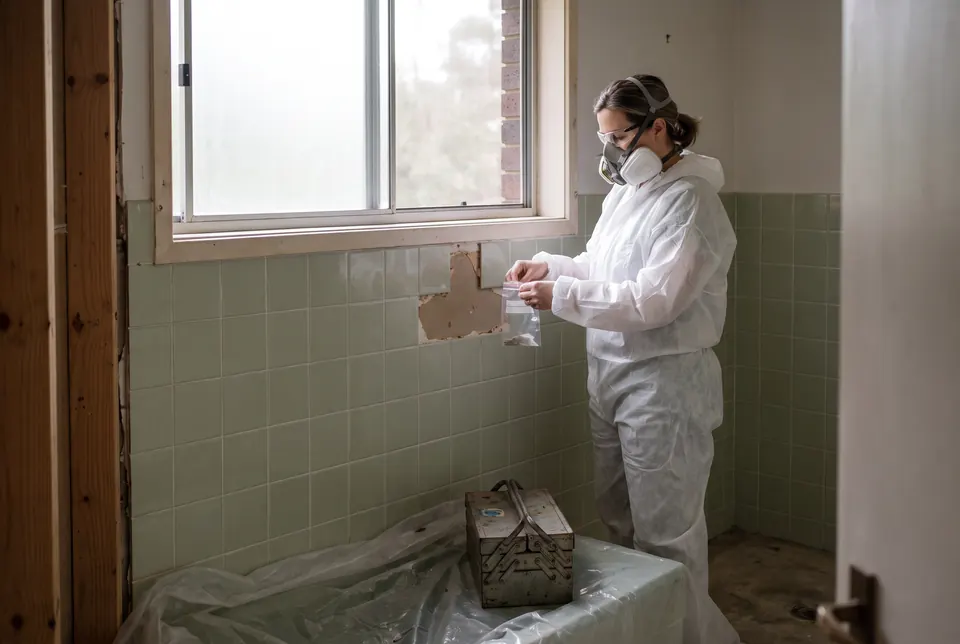
An assessor in a white coverall and respirator bagging a small sample from behind a lifted tile in an old green-tiled bathroom

How we work around the test

We don't test, remove or carry asbestos. What we do is keep the rest of the job moving around the people who do.

  • Empty the rooms early, so the walls and floors being tested are easy to get to
  • Leave anything with old sheeting attached until there's a result for it
  • Hold our load from any room with asbestos in it until the contractor has finished there
  • Take the cabinets, vanity and fittings once they're out, as long as nothing untested came off with them

If we come across sheeting nobody mentioned while we're loading, we stop, leave it where it is and tell you.

We won't load

  • Asbestos, loose or wrapped
  • Sheeting, vinyl or tiles that haven't been tested
  • Broken fibro mixed through other rubbish
  • Soil from where old sheeting was buried

Asbestos can only go to a landfill licensed to accept it, and Northern Beaches Council's bulky goods collection doesn't take it either.

Found sheeting you weren't expecting

asbestos.nsw.gov.au's rule is to treat anything that might be asbestos as if it is: stop work, keep people away from it, and get a licensed assessor to look.

The same site makes the practical point too: asbestos is cheaper and easier to deal with when it isn't a surprise. That's the reason to test before the trades rather than stop halfway through them.

Removing a small amount yourself

Bonded asbestos of 10 square metres or less doesn't legally need a licensed contractor, but asbestos.nsw.gov.au strongly recommends you don't do it yourself. If you do, the EPA's disposal rules apply.

Where it goes
Only a landfill licensed to accept asbestos
Before you drive
Phone the landfill: some need 24 hours' notice and set packing rules
Over 100 kg or 10 m²
Report the trip to the EPA within 24 hours after delivery

How to remove asbestos safely

Questions about testing before a renovation

Our house was renovated in the 1990s. Does it still need testing?

Only the parts that went in after 1990 are past the EPA's line. A later bathroom can be tiled over the original wall sheeting, and new flooring is sometimes laid straight over old vinyl. Test whatever the work will disturb that could be original.

Is it safe to live with until the work starts?

The EPA's advice is that asbestos in good condition, unlikely to be damaged, is often best left alone. Sealed and painted, it's lower risk. Don't drill, sand or cut into it while you wait.

Will you take the old kitchen if the wall behind it hasn't been tested?

We'll take the cabinets, benchtop and appliances once they're out, as long as no wall sheeting or tiles came away with them. Anything with sheeting attached waits for a result.

Does testing hold up the renovation?

It adds a step before the trades, not in the middle of them. Booking the assessor when you book the trades gives the result time to come back before the start date. The planner flags which of your loads could disturb old sheeting.

Can the builder's skip take it?

No. Asbestos can only be disposed of at a landfill licensed to accept it, packed to that landfill's rules. It doesn't go in with the general renovation waste, and a licensed contractor can remove it and dispose of it in one job.

How do I find a licensed assessor?

SafeWork NSW licenses asbestos assessors, and asbestos.nsw.gov.au links to the list. Check the licence on SafeWork's site before you book.


Sources

  1. Dealing with household asbestosNSW EPA. The 1990 line, friable and bonded, the licence thresholds, loose-fill insulation, disposal and transport reporting.
  2. Asbestos in the homeasbestos.nsw.gov.au. Where it's found inside and outside a house, and which materials are friable.
  3. Getting an asbestos sample testedasbestos.nsw.gov.au. Who can take and test samples, and the NATA-endorsed certificate.
  4. Find a licensed asbestos assessorasbestos.nsw.gov.au. What an assessor does, from inspection to clearance certificates.
  5. AsbestosSafeWork NSW. Friable and non-friable removal licences, the 10 square metre threshold, and clearance for friable work.
  6. Check a licenceSafeWork NSW.
  7. What we can and can't collectNorthern Beaches Council. Asbestos is excluded from the bulky goods collection.

Tell us about the job

A few lines is plenty. We ring you back, come and look at it, and agree one fixed price before anything is lifted.

No hourly rate, no tip fees on top. The price covers loading, sweeping up and taking it to a licensed facility. If the job changes on the day, we agree the change before we carry on.

We use your details to ring you back about this job. If another local crew is better placed to do it, we may pass it to them. No mailing list.